How to Use Trading Confluences to Filter Entries and Avoid Low-Quality Setups
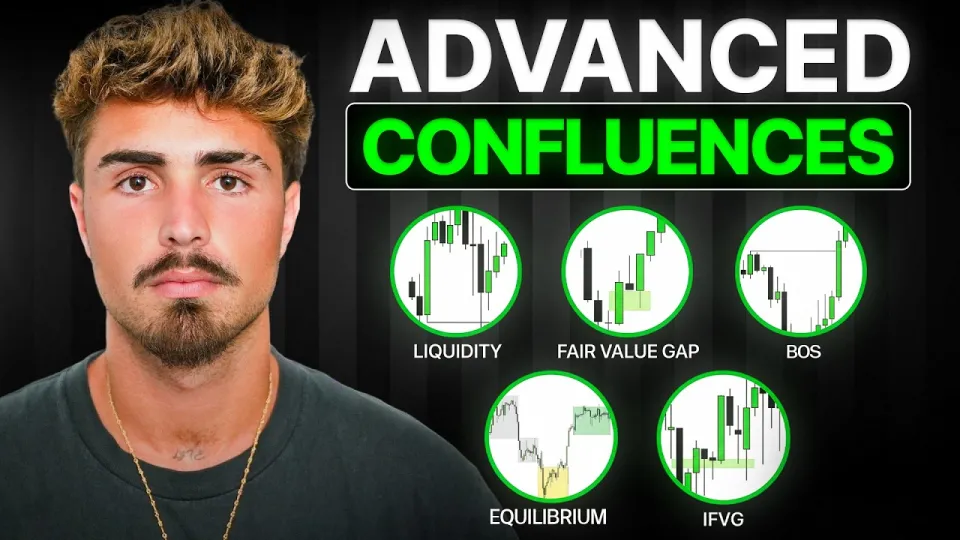
Video: Learn Every Trading Confluence In 18 Minutes
Need articles like this for your video? They help promote it on YouTube and Google — order them in the Telegram bot @sat_sit_bot. It writes articles around your video, embeds the video and publishes them on popular niche websites (no ads). Free trial — 50 articles.
· based on the channel TJR
Trading with confluences means waiting until several independent signals — a liquidity sweep, a fair value gap, a break of structure — point at the same price area before you take an entry. Instead of acting on one pattern in isolation, you stack evidence and only trade when enough of it agrees. TJR's breakdown of the main confluence types in "Learn Every Trading Confluence In 18 Minutes" is a useful checklist of what to look for; the same framework is outlined in the free trader blueprint the channel points to.
What a confluence actually is in trading
A confluence is a second, independent reason to take a trade that already has a first reason. A fair value gap on its own is a shape on a chart; the same gap sitting at a swept low, in line with the higher-timeframe trend and right after a break of structure, is a confluence. The point is not decoration — each added factor removes a class of losing setups, which is why the most liked comment under the video argues the real skill is knowing which confluences add value to your strategy rather than collecting all of them.
Two rules keep the idea honest:
- The factors must be independent. A fair value gap and an order block drawn on the same candle are not two confluences, they are one zone described twice.
- The factors must be testable. If you cannot write down the condition precisely enough for another person to check it, it is a feeling, not a confluence.
The five confluences TJR walks through
The video's structure is a tour of the concepts most retail price-action traders use, each one a potential layer in an entry checklist. In plain terms:
- Liquidity — clusters of stop orders above equal highs or below equal lows. Price often trades into those clusters before reversing, so a sweep of liquidity is treated as a signal that the move is being engineered, not organic.
- Fair value gap (FVG) — a three-candle imbalance where the wicks of candle one and candle three do not overlap, leaving a gap in the middle candle. Traders treat the gap as an area price may return to before continuing.
- Inverse fair value gap (IFVG) — an FVG that price breaks straight through instead of respecting. Once broken, the same zone is watched from the other side, flipping from support to resistance or the reverse.
- Equal highs and equal lows — two or more highs or lows at nearly the same price. They mark obvious liquidity and are one of the easiest confluences to spot on any timeframe.
- Break of structure (BOS) — a close beyond a prior swing high or low that confirms the direction of the current leg. A BOS tells you which side of the market is in control; the pullback that follows is where the other confluences get used.
The order matters less than the logic: liquidity tells you where stops sit, the gap tells you where price may return, the break of structure tells you which direction to trust.
How to stack confluences without over-filtering
Stacking confluences is a trade-off, and the trade-off has a hard limit: every condition you add cuts the number of setups, and past a certain point you are left with none. A trader who demands liquidity sweep plus FVG plus BOS plus higher-timeframe alignment plus a specific session will take perhaps one trade a week and will not have enough data to know whether the filter works.
A practical way to build your own checklist:
- Pick a direction filter first — for example, trade only with the higher-timeframe break of structure.
- Add one location factor: a fair value gap, an inverse FVG, or a swept equal high or low.
- Add one confirmation: a lower-timeframe BOS or a rejection candle inside the zone.
- Stop there. Three conditions is usually enough to cut random entries without starving the sample.
- Log every setup, taken or skipped, so the journal can tell you which layer actually improved results.
If a confluence never appears in your losing trades but appears in most winners, it earns its place. If it appears everywhere, it is noise.
Position sizing and risk come before any confluence
The strongest confluence in the world does not survive bad sizing. Confluences describe probability, not certainty: liquidity gets swept and price keeps going, fair value gaps get filled and ignored, breaks of structure fail on the next candle. That is normal, not a flaw in the method.
Before adding a fourth or fifth layer to your checklist, fix the boring parts — a defined risk per trade, a stop placed where the idea is wrong rather than where the loss feels comfortable, and a maximum daily loss that ends the session. The video's own description is blunt about this: day trading is risky and most day traders lose. Confluence work improves the quality of your entries; risk control is what keeps you in the game long enough for that improvement to show up in the numbers.
Common questions traders raise about confluences
Most of the pushback on confluence-based trading comes from the same few places, and they are worth answering directly.
"Which confluence is the most important?" There is no universal ranking, because it depends on the strategy. Scalpers on a one-minute chart lean on liquidity sweeps and inverse FVGs; swing traders care more about the higher-timeframe break of structure. Test on your own instrument and session.
"Do I need all five?" No. Waiting for all five is the fastest route to a strategy with no trades. Two or three well-chosen layers is the usual sweet spot.
"Why do I keep losing even with confluences?" Usually because the sample is tiny, the risk per trade is too large, or the confluence was defined loosely after the fact. A journal exposes all three.
"Isn't the market manipulated anyway?" Large players do hunt liquidity, which is exactly why liquidity is on the list — but "manipulated" is not a plan. Trade the reaction at the level you marked, with a stop, and accept that some of those reactions will fail.
Useful links
- Trader blueprint and full system: https://go.tjrtrades.com/blueprint-nviugv1
- Indicators used on the channel: https://go.tjrtrades.com/indicators-6qf6zb4
- Funded account raffle: https://form.tjrtrades.com/funded-contest
- Alpha Futures (10% off funded accounts): https://app.alpha-futures.com/signup/TJR/
- Lucid Trading (40% off): https://lucidtrading.com/ref/TJR/
The takeaway
Confluences are a filtering tool, not a prediction machine: liquidity, fair value gaps, inverse FVGs, equal highs and lows, and breaks of structure each remove a category of bad entry, and the trader's job is to choose the two or three that fit their timeframe and style. Build the checklist, size every trade as if the confluence will fail, and let a journal — not memory — decide which layers stay. The full walkthrough of these concepts comes from TJR, whose 18-minute format makes it easy to review one idea at a time; if you want the structured version, start with the blueprint and paper-trade the checklist before risking real capital.
Key takeaways
- A confluence is any independent piece of evidence — liquidity, an FVG, a break of structure — that lines up with your entry idea.
- TJR's 18-minute breakdown covers liquidity, fair value gaps, inverse fair value gaps, equal highs/lows and break of structure.
- Stacking every confluence at once produces almost no trades; the skill is selecting the two or three that fit your own strategy.
- Confluences describe where price is likely to react, not a guarantee — risk per trade still decides survival.
- A trading journal is what separates real edge from remembered wins when you test which confluences pay.
Questions & answers
How many confluences should I use per trade?
Most traders do well with two or three independent layers: a direction filter such as a higher-timeframe break of structure, a location factor such as a fair value gap or swept liquidity, and one confirmation. Adding more conditions quickly reduces your trade count to the point where you cannot tell whether the filter helps or just makes you inactive.
What is the difference between a fair value gap and an inverse fair value gap?
A fair value gap is a three-candle imbalance that price may return to and respect. An inverse fair value gap is the same zone after price has broken straight through it — traders then watch it from the opposite side, expecting it to act as resistance instead of support, or the reverse.
Why do I still lose trades when several confluences line up?
Confluences describe where price is likely to react, not a guarantee that it will. Losses usually come from oversized risk, a sample too small to judge, or conditions defined loosely after the fact. Logging every setup, including skipped ones, shows whether the layers you use actually separate winners from losers.
Do I need paid indicators to trade confluences?
No. Liquidity, fair value gaps, equal highs and lows, and breaks of structure can all be marked on a plain candlestick chart. Indicators can speed up marking, but the edge comes from consistent definitions and risk control, not from the tool itself.
Source: Learn Every Trading Confluence In 18 Minutes · Markdown version